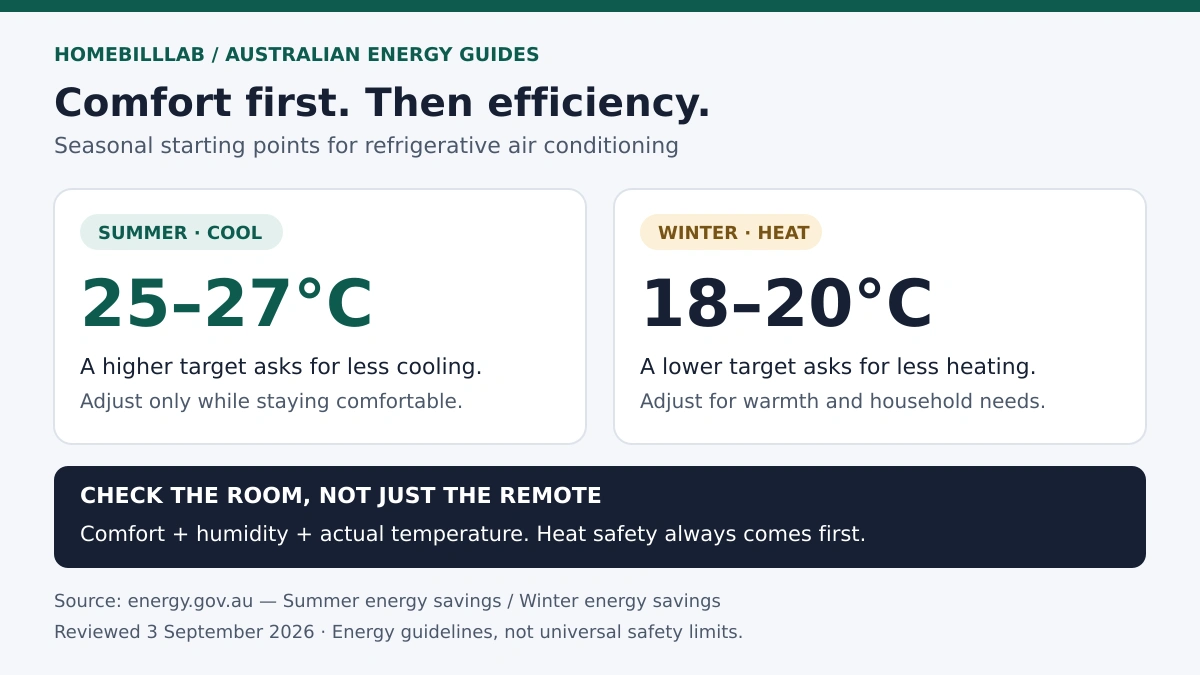
The best air conditioner temperature to save energy in Australia is a comfortable setting that avoids unnecessary cooling or heating. For summer, 25–27°C is a useful starting range, according to Australian Government summer guidance. It is not a compulsory target for every household or a guarantee that every room will feel comfortable.
This guide covers thermostat choices for refrigerative air conditioners, including reverse-cycle split systems. It explains seasonal settings, fans, humidity and how to test the cost difference using your own electricity rate. Health and safe indoor conditions come before an energy-saving target.
What temperature should you set your air conditioner to?
| Situation | Starting point | What to check |
|---|---|---|
| Summer cooling | 25–27°C in cool mode | Comfort, humidity and the actual occupied-room temperature |
| Winter reverse-cycle heating | 18–20°C in heat mode | Warmth, draughts and household needs |
| Sleeping | A comfortable seasonal setting | Whether a timer or sleep mode maintains comfort overnight |
| Extreme heat or heat-sensitive occupants | Prioritise safe cooling | Local health advice and individual needs, not a rigid energy target |
The winter range comes from Energy.gov.au’s winter advice. South Australia’s cooling guidance gives a slightly broader summer range of 24–27°C, or higher when comfortable. These are starting ranges, not competing promises about one perfect degree.
A practical summer trial is 26°C, then small adjustments after the room has settled. If that feels too warm, make it more comfortable. If it feels unnecessarily cold, try a higher setting. Avoid choosing 18°C simply because the remote allows it.
Why the thermostat changes energy use
In cooling mode, a lower target asks the system to maintain a colder indoor space against outdoor heat and heat entering the building. In heating mode, a higher target asks for more warmth. The setpoint is a target temperature, not a direct electricity-consumption setting.
Energy.gov.au’s heating and cooling guidance gives a broad 5–10% increase in energy use for each degree of extra heating or cooling. Treat that as indicative guidance, not a guaranteed saving for your appliance. Do not apply it to your entire electricity bill or assume several degrees produce a perfectly linear saving.
A thermostat choice cannot tell you the air conditioner’s daily kWh on its own. Weather, operating hours, room size and the building all matter. For a broader cost estimate, see how much an air conditioner costs to run.
For example, two homes both set to 26°C can have very different bills. One might cool a shaded bedroom for two hours; the other might cool an open-plan living area through a sunny afternoon. The matching number on the remotes does not make their cooling needs, equipment or electricity use equivalent. Compare changes within your own home before drawing conclusions from someone else’s bill.
Check comfort where people actually sit
A remote showing 26°C does not prove every part of the room is 26°C. A reading near the air outlet, a sunny window or a warm appliance can differ from conditions at the sofa. A separate room thermometer can help you observe the occupied area without repeatedly changing the controller.
YourHome explains that comfort depends on air movement, humidity and surrounding surface temperatures as well as air temperature. A shaded seat may feel better than one beside sun-heated glass, even before you touch the thermostat.
Try gentle fan airflow while the air conditioner runs. A fan moves air across people; it does not lower the room’s air temperature. This can make a higher cooling setting comfortable, but include the fan’s electricity use when comparing costs. Our air conditioner versus fan running-cost guide explains that distinction.
Humidity and dry mode: temperature is only part of the answer
A sticky room in coastal Queensland can feel different from a dry room at the same temperature. The Australian Government’s tropical and sub-tropical living guide discusses dehumidifying functions as an option for humid conditions, alongside fans and cooling only the rooms being used.
If your unit has dry mode, read its manual before using it as an alternative to cool mode. Do not assume every model controls temperature or humidity in the same way, or that dry mode always uses less electricity. Check the room’s comfort and the unit’s reported consumption, where available. If effective cooling is needed, do not keep an unsuitable mode running just because its name sounds economical.
Evaporative cooling is different: it adds moisture and needs an appropriate airflow path through the home. The closed-window approach for a split-system refrigerative air conditioner should not be transferred to an evaporative system.
Use winter settings differently
For reverse-cycle heating, begin around 18–20°C and adjust for comfort. A summer setting of 26°C is not an economical default for winter heating. Select heat mode and check that an old summer schedule is not still active.
Before raising the setting repeatedly, check whether draughts or uncovered windows are making the occupied area uncomfortable. Suitable clothing and closing curtains after sunset can help. This is practical energy guidance, not a medical minimum: some occupants need a warmer environment.
Timers, sleep mode and hot nights
Use schedules to match when cooling is needed. A forgotten daily timer can run the system in an empty room, while a poorly chosen off-time can leave a bedroom uncomfortable. Read the manual to understand whether sleep mode changes the temperature, fan speed or operating time on your model.
There is no universal rule that leaving the air conditioner on all day is cheapest. Pre-cooling may shift electricity use into a cheaper period, but it is not automatically an energy saving. The result depends on how well the building retains cool air and what the tariff actually charges.
During hot nights, do not turn off necessary cooling just to follow a timer recommendation. NSW Health’s heat advice supports using available air conditioning and keeping the home cool. Follow local health guidance, particularly when someone is more vulnerable to heat. If your home cannot stay safely cool, identify an accessible cooler place rather than relying on thermostat experimentation.
Measure the difference instead of guessing
Compare similar operating periods while changing one thing at a time. Note the setting, hours, outdoor conditions, rooms cooled, fan use and comfort. Several comparable observations are more useful than one cool cloudy day versus one hot sunny day.
Use existing appliance energy monitoring if available. Energy.gov.au’s smart-home guide explains household energy displays and smart-meter data. Whole-home readings include other appliances, so they cannot isolate air-conditioning use when cooking, hot-water heating or other loads also change. No electrical-panel access or wiring work is needed for this exercise.
Also check what the display measures. Grid imports, total household consumption and air-conditioner consumption are different quantities. With rooftop solar, a sunnier day can reduce imports even if the air conditioner uses the same energy. A battery can change imports too. Label observations clearly and avoid calling a fall in grid imports a measured thermostat saving unless those other effects have been accounted for.
Illustrative calculation only: suppose two comparable six-hour sessions use 6.0 kWh and 5.2 kWh of measured air-conditioning electricity. These are invented teaching inputs, not predicted consumption at particular temperatures. Assume grid-supplied electricity at 30 c/kWh, with no solar or battery contribution.
| Session | Energy | Assumed usage rate | Energy cost |
|---|---|---|---|
| A | 6.0 kWh | $0.30/kWh | $1.80 |
| B | 5.2 kWh | $0.30/kWh | $1.56 |
| Difference | 0.8 kWh | $0.30/kWh | $0.24 |
The arithmetic is energy used × usage rate. The difference is $0.24 for these sessions, not a promised saving per degree or per day. Twenty identical repeats would equal $4.80; real weather and behaviour rarely repeat exactly. If a fan is added only in session B, include its energy too.
Use your own rate in the Air Conditioner Running Cost Calculator. For its power-and-usage mode, 6.0 kWh over six hours corresponds to a measured average electrical input of 1.0 kW. Do not enter the unit’s advertised cooling capacity: Victoria’s equipment guidance explains that its size in kW refers to heating or cooling output.
With time-of-use pricing, calculate each period’s kWh at the relevant rate. Leave the fixed daily supply charge out of this marginal appliance comparison; Energy Made Easy distinguishes supply and usage charges. See our Methodology for calculation boundaries.
A short checklist before lowering the temperature
- Shade sun-facing windows before the room overheats.
- Keep windows closed while refrigerative cooling operates; ventilate when outdoor conditions are cooler and suitable.
- Cool occupied areas using approved zone controls. Keep required return-air paths clear.
- Check accessible filters according to the manual. Leave electrical, refrigerant and inaccessible maintenance to qualified professionals.
- Review mode and timer settings after a season change.
If the room still cannot reach a comfortable temperature, do not treat a lower setpoint as a repair. The system may need a professional performance or sizing assessment.
Frequently asked questions
Is 24°C or 26°C better for saving electricity?
In cooling mode, 26°C asks for less cooling than 24°C. Whether it suits you depends on comfort and conditions. In heating mode the direction reverses: a higher target asks for more warmth.
Does 27°C mean the room is safe during a heatwave?
No. A controller setting is not a safety assessment or proof of the room temperature. Follow heat-health guidance and individual needs rather than treating an energy-saving range as a universal safety limit.
Can a thermostat setting predict my bill?
No. You also need electricity use and the applicable tariff. Our air conditioner electricity-use guide explains how to choose suitable consumption figures.
The bottom line
Start with seasonal guidance, adjust for the people and room, and measure before claiming savings. Explore the Air Conditioning hub for related Australian guides.
Reviewed: 3 September 2026 by HomeBillLab Editorial Team. Review annually before summer, or sooner if official guidance changes. General energy information, not individual health advice or a guaranteed bill estimate.