Split system running cost depends on the electricity the unit actually draws, how long it operates and the usage rate on your electricity plan. The large capacity number advertised on the unit—such as 2.5kW, 5kW or 7kW—is not automatically its electrical consumption.
Quick answer: at an illustrative tariff of 32c/kWh, a split system averaging 0.65kW of electrical input costs about 21 cents per hour. A system averaging 1.2kW costs about 38 cents per hour, while one averaging 2.0kW costs about 64 cents per hour. These are calculation scenarios, not Australian averages.
Enter your own input power, runtime and tariff in the Air Conditioner Running Cost Calculator for a more relevant estimate. You can also explore the HomeBillLab air-conditioning guides.
Split system running cost per hour: example scenarios
The basic hourly calculation is:
Cost per hour = average electrical input (kW) × electricity tariff ($/kWh)
The table uses the same 32c/kWh tariff for every row so the effect of electrical input is easy to see. It assumes six operating hours per day for the daily and 30-day examples.
| Average electrical input | Cost per hour | Cost for 6 hours | Cost for 30 days |
|---|---|---|---|
| 0.65kW | $0.21 | $1.25 | $37.44 |
| 1.2kW | $0.38 | $2.30 | $69.12 |
| 2.0kW | $0.64 | $3.84 | $115.20 |
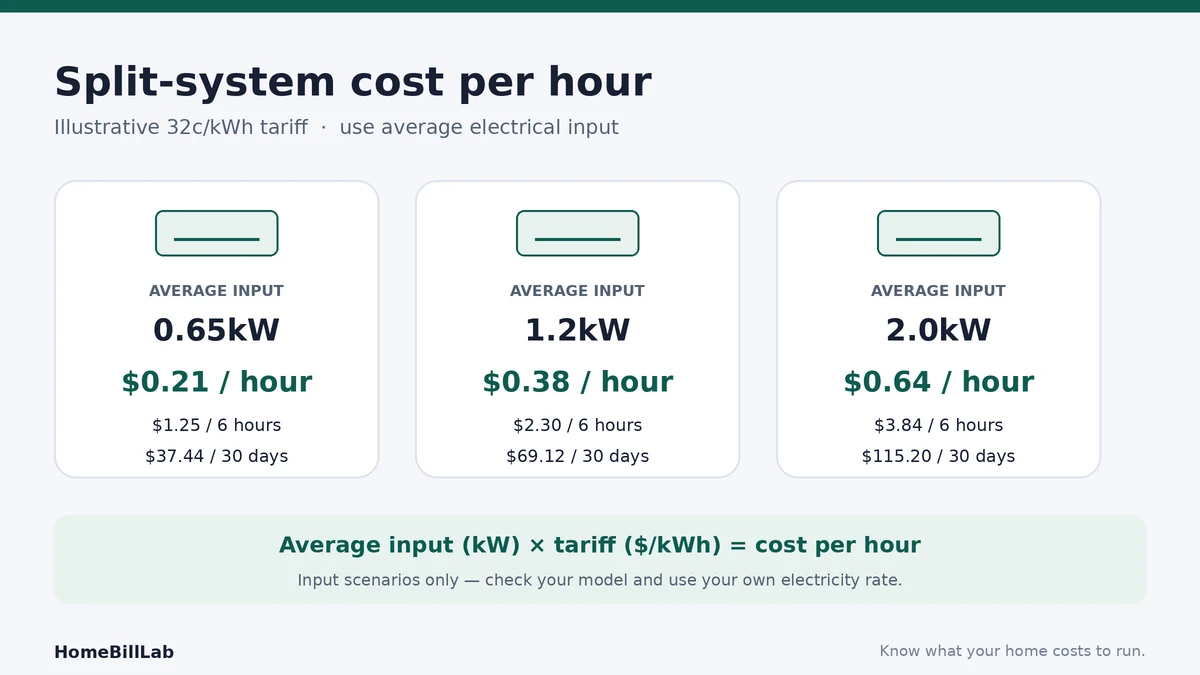
These rows are input-power scenarios, not promises about small, medium or large systems. Two units with the same cooling capacity can have different efficiency, and an inverter system’s input can change from minute to minute.
Use electrical input, not cooling capacity
Cooling capacity measures how much heat the unit can remove. Electrical input measures the power it draws from the electricity supply. Both may be shown in kilowatts, which makes them easy to confuse.
For example, a unit described as a “5kW split system” normally means about 5kW of cooling capacity. It does not mean the unit continuously consumes 5kW of electricity. Using capacity as input can greatly overstate the result.
Look in the specification sheet for terms such as rated power input, cooling input or electrical input. Our separate guide to how much electricity an air conditioner uses explains capacity, input power and kilowatt-hours in more detail.
Why the actual hourly cost changes
An inverter split system does not necessarily draw its rated input for every minute it is switched on. It may use more power while bringing a hot room towards the set temperature, then reduce compressor speed as the cooling load falls. A simple input-times-hours estimate is most useful when the input represents a realistic operating average.
The actual split system running cost can change with:
- Outdoor temperature and humidity: tougher conditions can increase the work required.
- Thermostat setting: a colder cooling setting generally increases energy use.
- Room size and heat gain: windows, direct sun, occupants and appliances add heat.
- Insulation and draughts: a room that gains heat quickly needs more ongoing cooling.
- System size and efficiency: correct sizing and a stronger efficiency rating can improve performance.
- Airflow and maintenance: dirty filters or restricted indoor and outdoor airflow may reduce effective operation.
- Zoning behaviour: cooling one occupied room is different from trying to condition several open areas.
The Australian Government’s heating and cooling guidance explains that reverse-cycle air conditioners transfer heat rather than creating it directly. It also notes that the performance of available models varies, so comparing suitable systems matters.
How to calculate hourly, daily and monthly cost
Step 1: find or estimate average electrical input
Use a cooling input figure from the model’s technical information when estimating cooling cost. If the unit varies its input, one fixed figure cannot represent every condition. A compatible energy monitor or measured household interval data may help, but other appliances must be separated from the result.
Step 2: copy your electricity usage rate
Use the variable usage rate from your bill or plan and convert cents to dollars. For example, 32c/kWh becomes $0.32/kWh. Do not add the daily supply charge to a single-appliance comparison because that fixed charge is generally payable whether the split system runs or not.
If you are on a time-of-use plan, make separate estimates for peak, shoulder and off-peak cooling hours. One blended tariff can hide when the electricity is actually being consumed.
Step 3: multiply by realistic operating time
A 1.2kW average input used for five hours consumes 6kWh. At 32c/kWh, that costs $1.92. If this happens on 20 days, the scenario costs $38.40. The arithmetic is transparent:
- 1.2kW × 5 hours = 6kWh per day.
- 6kWh × $0.32/kWh = $1.92 per day.
- $1.92 × 20 days = $38.40.
This method follows the transparent calculation principles in the HomeBillLab Methodology. Keep the power, hours, days and tariff visible so another person can reproduce the estimate.
When the Zoned Energy Rating Label is more useful
A per-hour scenario is useful for a bill-impact question, but it cannot fully represent seasonal inverter behaviour. For comparing models, the Zoned Energy Rating Label provides estimated annual cooling and heating energy use for hot, average and cold climate zones.
The official Zoned Energy Rating Label guide explains that climate-specific ratings reflect different operating conditions across Australia and New Zealand. The Energy Rating heating and cooling page shows where the annual kWh figures appear on the label.
To estimate annual cost from the label, select the relevant cooling kWh figure and multiply it by your tariff. For example, 500kWh at $0.32/kWh equals $160. This remains a standardised estimate, not a forecast of your exact bill. Your climate, settings, building and usage can differ from the label assumptions.
Recent Australian Government guidance on the Zoned Energy Rating Label also stresses comparing efficiency among systems suited to the space. A high-efficiency unit that is poorly sized is not automatically the best choice.
Practical ways to control split system running cost
- Use a moderate cooling setting. Australian Government summer guidance suggests 25°C to 27°C and says each degree higher may save 5% to 10% on energy costs.
- Close the cooled zone. Shut external windows and doors while the system is operating, unless ventilation is required.
- Reduce direct sun. Blinds, curtains and external shading can reduce heat entering the room.
- Use fans strategically. Air movement may allow a higher thermostat setting. Compare the air conditioner vs fan running cost before choosing a scenario.
- Clean filters as directed. Follow the manufacturer’s maintenance instructions rather than waiting for airflow to become noticeably restricted.
- Use timers thoughtfully. Avoid cooling an empty room for longer than needed, while still following appropriate hot-weather health guidance.
Test changes as separate scenarios instead of assuming a fixed saving. For example, compare five hours at one average input with four hours at another. The calculator will show the arithmetic, but only real operation can establish what your system does in your home.
Frequently asked questions
What affects split system running cost the most?
The strongest direct inputs are average electrical power, operating time and electricity tariff. Weather, thermostat setting, heat entering the room, system efficiency and maintenance influence the power and time. A useful split system running cost estimate therefore shows every assumption instead of relying on one generic hourly figure.
How much does a split system cost to run per hour?
Multiply its average electrical input in kW by your electricity rate in dollars per kWh. At 32c/kWh, inputs of 0.65kW, 1.2kW and 2.0kW cost about $0.21, $0.38 and $0.64 per hour respectively. These inputs are examples only.
Is a 5kW split system using 5kW of electricity?
Usually the 5kW figure refers to cooling capacity, not electrical input. Check the technical specifications for the rated cooling input or another clearly identified electrical-input figure.
Can I calculate cost from the maximum input?
You can use maximum input as a deliberately high scenario, but it may overstate normal inverter operation. Label the result clearly and compare it with a more realistic average-input scenario.
Does a split system use the same power all night?
Not necessarily. An inverter compressor can change speed as the room load changes. Weather, thermostat setting, insulation and heat entering the room influence how much it needs to run.
Is split system running cost lower than ducted air conditioning?
It can be lower when one split system cools only an occupied room instead of a larger ducted area, but equipment efficiency, zoning, duct losses, room load and operating behaviour all matter. Compare actual input and usage rather than system names alone.
Bottom line
The most useful split system running cost estimate starts with electrical input, not cooling capacity. Multiply a realistic average input by operating time and the usage tariff from your own electricity plan. Use per-hour scenarios for immediate bill questions and the Zoned Energy Rating Label for standardised annual model comparisons.
Reviewed: 22 August 2026. This guide provides calculation guidance and illustrative scenarios, not a quote for a particular air conditioner, electricity plan or household.