How much electricity does an air conditioner use? There is no single figure that applies to every Australian home. Electricity use depends on the system’s electrical input, how long it runs, how hard it is working and how often an inverter compressor slows down or cycles. The most reliable starting points are the input power in the manufacturer’s specifications and the annual cooling or heating figures on the Zoned Energy Rating Label.
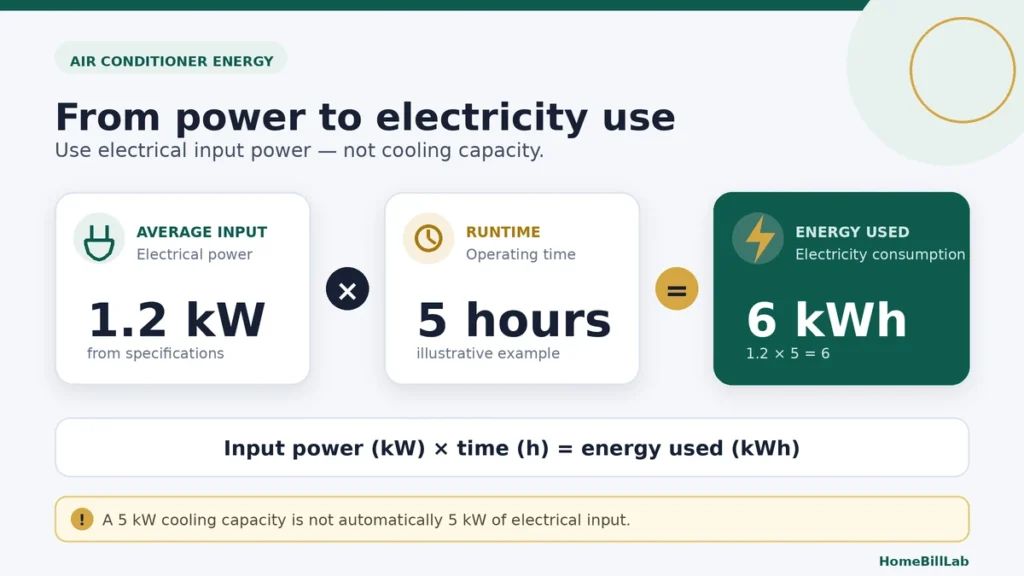
Quick answer: if an air conditioner averages 1.2 kW of electrical input for one hour, it uses 1.2 kWh. If it averages that input for five hours, it uses 6 kWh. These are calculation examples, not national averages. Your actual result can be lower or higher.
Air conditioner power and energy are not the same thing
Power describes the rate at which the air conditioner is drawing electricity at a particular time. It is shown in watts (W) or kilowatts (kW). Energy is the amount used over time and is measured in kilowatt-hours (kWh). Electricity bills charge for energy, not simply for the kW number printed in a product name.
- Watts or kilowatts: electrical power at a point in time.
- Kilowatt-hours: electrical energy used over a period.
- Cooling or heating capacity: the amount of heating or cooling the system can deliver, not necessarily the electricity it draws.
The basic relationship is:
Electricity used (kWh) = average electrical input (kW) × operating time (hours)
This follows the same transparent calculation approach explained in the HomeBillLab Methodology. The word average matters because an inverter air conditioner may not draw its rated input continuously.
How much electricity does an air conditioner use per hour?
For one hour, the kWh figure is numerically the same as the average input in kW. A system averaging 0.9 kW for one hour uses 0.9 kWh. A system averaging 2.0 kW for one hour uses 2.0 kWh.
| Average electrical input | Electricity in 1 hour | Electricity in 4 hours | Electricity in 8 hours |
|---|---|---|---|
| 0.5 kW | 0.5 kWh | 2.0 kWh | 4.0 kWh |
| 0.9 kW | 0.9 kWh | 3.6 kWh | 7.2 kWh |
| 1.5 kW | 1.5 kWh | 6.0 kWh | 12.0 kWh |
| 2.5 kW | 2.5 kWh | 10.0 kWh | 20.0 kWh |
Do not select a row just because it looks similar to the cooling capacity advertised for your system. Find the electrical input or use the energy label instead. Real consumption also changes during the hour as the compressor responds to indoor and outdoor conditions.
Why a 2.5 kW air conditioner may not use 2.5 kW of electricity
A size such as 2.5 kW, 5 kW or 7 kW commonly refers to the unit’s cooling or heating capacity. That is output capacity. It should not automatically be entered as electrical input.
Reverse-cycle air conditioners move heat rather than producing the same amount of heat directly from electricity. The Australian Government explains that an air conditioner can use one unit of electrical energy to deliver about three to six times as much heating or cooling energy. This is why output capacity can be much larger than electrical input. See the government’s heating and cooling guidance.
Look for terms such as rated input, power input, cooling input or heating input in the product specification. Some documents also show minimum, rated and maximum inputs. Use the value that matches the scenario you are estimating, and state the assumption.
Where to find your air conditioner’s electricity use
1. Manufacturer specifications
Search the model number in the manufacturer’s specification sheet or user manual. Check that you are reading electrical input rather than cooling capacity. If separate cooling and heating inputs are listed, choose the operating mode you want to estimate.
2. The Zoned Energy Rating Label
Australian air conditioner labels provide climate-zone information and estimated annual energy use for cooling and heating. The hot, average and cold zones help show that the same model can perform differently across climates. The official guide to the Zoned Energy Rating Label also advises comparing models with a similar size or capacity rather than comparing unrelated sizes by stars alone.
3. The Energy Rating Calculator
The Australian Government’s Energy Rating Calculator can be used to find and compare registered models. This is useful when you have a model number or when you are comparing systems of a similar capacity.
4. Measured household data
A smart meter or home energy monitor can help show how household demand changes when the air conditioner operates, but other appliances may be running at the same time. Do not disconnect, open or modify a fixed-wired system to measure it. If circuit-level monitoring is required, use suitable equipment installed by a licensed electrician.
Why actual electricity use changes
Even when two households own the same model, their kWh results can differ. Important factors include:
- Inverter operation and cycling: the compressor can reduce its input after the room approaches the set temperature.
- Outdoor temperature and climate: a larger difference between indoor and outdoor conditions can increase the work required.
- Thermostat setting: demanding a colder room in summer or a warmer room in winter generally increases energy use.
- Room size and zoning: conditioning unused rooms adds load.
- Insulation, draughts and glazing: heat entering or leaving the building changes how long the system must work.
- System size and efficiency: both poor sizing and lower efficiency can affect consumption and comfort.
- Filters and maintenance: follow the manufacturer’s cleaning and maintenance instructions so airflow is not unnecessarily restricted.
- Operating mode: cooling, heating, fan and dehumidification modes do not necessarily draw the same amount of power.
This is why multiplying a maximum input by every hour the system is switched on can overstate actual use, while assuming that it always runs at a very low input can understate it. Use a clearly labelled scenario rather than presenting one figure as guaranteed.
How to calculate air conditioner electricity use
Method 1: power and operating time
- Find or estimate the average electrical input in kW.
- Estimate the number of operating hours.
- Multiply kW by hours to calculate kWh.
- For cost, multiply kWh by your electricity usage rate in dollars per kWh.
Example: if the system averages 1.2 kW for five hours, electricity use is:
1.2 kW × 5 hours = 6 kWh
If the household usage rate were 32 cents per kWh, the illustrative usage cost would be:
6 kWh × $0.32 = $1.92
The 32-cent tariff is only an example. It is not presented as an Australian average. Use the usage rate from your own electricity bill or plan. Supply charges are not caused by one appliance and are normally excluded from an appliance running-cost estimate.
Method 2: annual energy from the label
If the Zoned Energy Rating Label provides estimated annual cooling or heating kWh for your climate zone, multiply that annual figure by your tariff. The Australian Government’s energy ratings guidance recommends using the energy consumption figure and the electricity rate shown on your bill when estimating annual running cost.
Label estimates are best treated as consistent comparison scenarios. Your household may use the system for different hours, at different settings or in a building with different thermal performance.
For either method, the Air Conditioner Running Cost Calculator can calculate energy and cost from electrical input and usage, or estimate annual cost from Energy Rating Label figures.
How to reduce air conditioner electricity use
- Use a moderate set temperature. Australian Government summer energy-saving guidance recommends 25°C to 27°C for cooling. Its broader heating and cooling guidance says each extra degree of heating in winter or cooling in summer can increase energy use by about 5% to 10%.
- Condition the occupied area. Close internal doors and avoid cooling or heating unused rooms when the system and layout allow zoning.
- Reduce unwanted heat transfer. Use appropriate shading, draught sealing and insulation to reduce the load on the system.
- Use timers and schedules. Avoid leaving the system operating when the space is unoccupied.
- Use fans strategically. Air movement can improve comfort and may allow a less demanding cooling setting.
- Maintain airflow. Clean filters and arrange servicing according to the manufacturer’s instructions.
- Compare similar systems. When buying, compare the climate-zone star rating and annual energy figures of models with a similar capacity.
These steps change the conditions under which the air conditioner operates. They do not guarantee a fixed percentage reduction for every home.
Frequently asked questions
Does an air conditioner use a lot of electricity?
It can be a major household load, especially when it serves a large area or operates for many hours. However, electricity use varies too widely to label every air conditioner as high or low consumption. Check the model’s input or annual energy label and calculate a scenario based on your usage.
How many kWh does an air conditioner use in eight hours?
Multiply its average electrical input in kW by eight. An average input of 0.9 kW would equal 7.2 kWh over eight hours. An average input of 1.5 kW would equal 12 kWh. Do not substitute cooling capacity for electrical input, and remember that inverter input may change through the day.
Does a 2.5 kW air conditioner use 2.5 kW of electricity?
Not necessarily. The 2.5 kW description commonly refers to cooling capacity. Find the rated electrical input in the specifications or use the Zoned Energy Rating Label. Entering capacity as input can produce a misleading estimate.
Does heating use more electricity than cooling?
It depends on the model, climate, temperatures and operating conditions. Check the separate cooling and heating input specifications or the separate annual figures on the Zoned Energy Rating Label instead of assuming one mode always uses more.
Will the energy label predict my exact electricity bill?
No. It provides a standardised estimate that is useful for comparing similar models and climate zones. Your tariff, hours, thermostat setting, home and weather can all differ from the label assumptions.
The bottom line
To answer “how much electricity does an air conditioner use?”, start with electrical input and operating time, or use the annual kWh figure for your climate zone. Keep cooling capacity separate from power input, use your own tariff for cost estimates and treat every result as a scenario rather than a guaranteed bill outcome.
Explore more practical guidance in the Air Conditioning hub.
Reviewed: 22 August 2026. Review cadence: every six months, or earlier if Australian Energy Rating guidance changes.