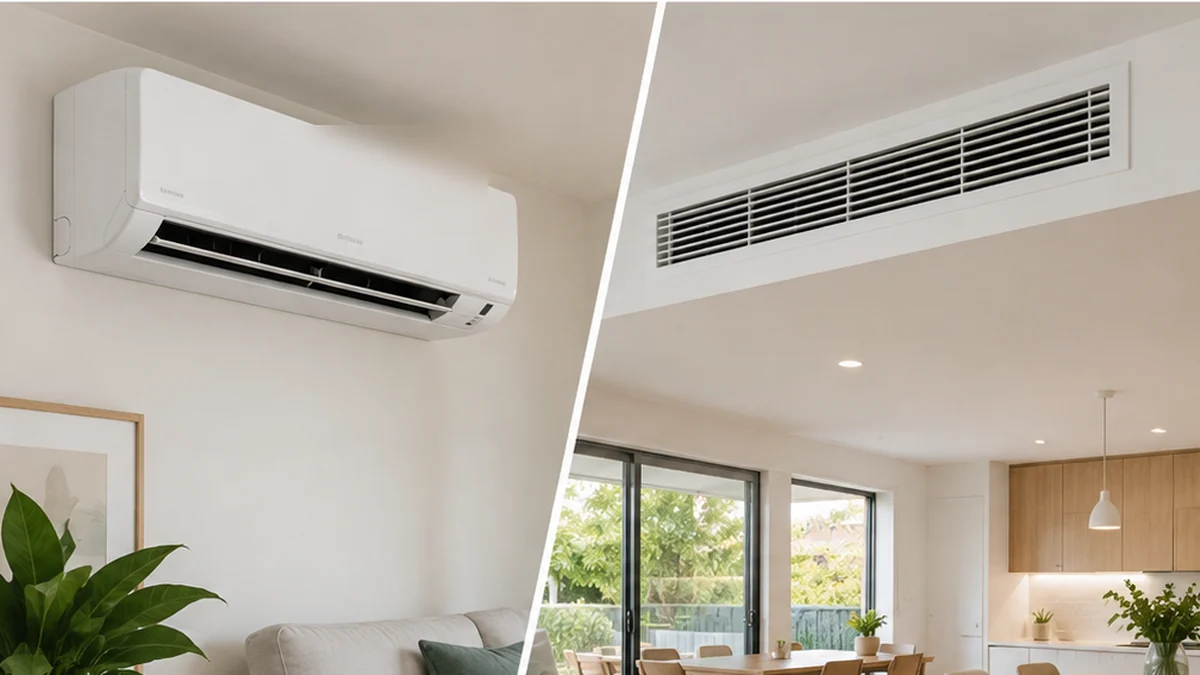
For most Australian homes, a wall-mounted split system will usually cost less to run when you only need to heat or cool one room or a small occupied zone. A ducted system can condition several rooms from one central system, but it also has a larger fan, ductwork and often a much larger conditioned area. That means split system vs ducted air conditioning running costs cannot be compared fairly from the system name alone.
The useful comparison is: how much electrical energy does each option use to keep the same occupied area comfortable, for the same period, at the same electricity tariff? The Australian Government’s heating and cooling guidance notes that ducted systems are generally less efficient than wall units because they use a larger fan and can lose energy through ductwork. However, zoning, system sizing, climate, insulation and how many rooms you actually use can change the result.
Use the HomeBillLab Air Conditioner Running Cost Calculator with a realistic electrical input, runtime and the usage rate from your own bill. If you are comparing a labelled non-ducted model, you can also use its climate-zone annual kWh. Do not treat the advertised cooling-capacity number—such as 2.5kW, 5kW or 12kW—as electricity consumption.
Table of Contents
Split system vs ducted: the quick running-cost comparison
| Factor | Wall-mounted split system | Ducted air conditioning |
|---|---|---|
| Typical area controlled | One room or one local zone per indoor unit | Several rooms or much of the home, often with zones |
| Air distribution | Short path from indoor unit directly into the room | Central fan moves air through ceiling or floor ducts |
| Duct losses | No central duct network | Possible heat gain/loss and leakage through ducts |
| Part-home use | Easy to run only the room being used | Depends strongly on zoning and system design |
| Efficiency comparison data | Non-ducted systems commonly have a Zoned Energy Rating Label | Ducted systems may not have a mandatory star-rating label |
The table explains why a split system can be the lower-cost choice for a household that spends most of its time in one or two rooms. It does not prove that every split system is more efficient than every ducted system. A well-designed, correctly sized and well-zoned ducted system can be appropriate where many rooms need conditioning at the same time.
How to calculate running cost for either system
The direct calculation is the same for both systems:
Electricity used (kWh) = average electrical input (kW) × operating time (hours)
Running cost = electricity used (kWh) × electricity tariff ($/kWh)
For example, if a system averages 1.0kW of electrical input for six hours, it uses 6kWh. At an illustrative tariff of $0.35/kWh, that is $2.10. A system averaging 2.8kW for the same six hours uses 16.8kWh and costs $5.88 at the same illustrative tariff. Those inputs are scenarios only; they are not Australian averages for split or ducted systems.
The best input is a realistic average electrical demand for the operating period, or suitable measured energy data. An inverter air conditioner does not normally draw one fixed amount of power all day. It can ramp up when the load is high and reduce compressor speed as the space approaches the set temperature. The Energy Rating heating and cooling guide explains that air-conditioner efficiency and capacity should be compared for the climate and size of system you actually need.
Why ducted air conditioning can use more electricity
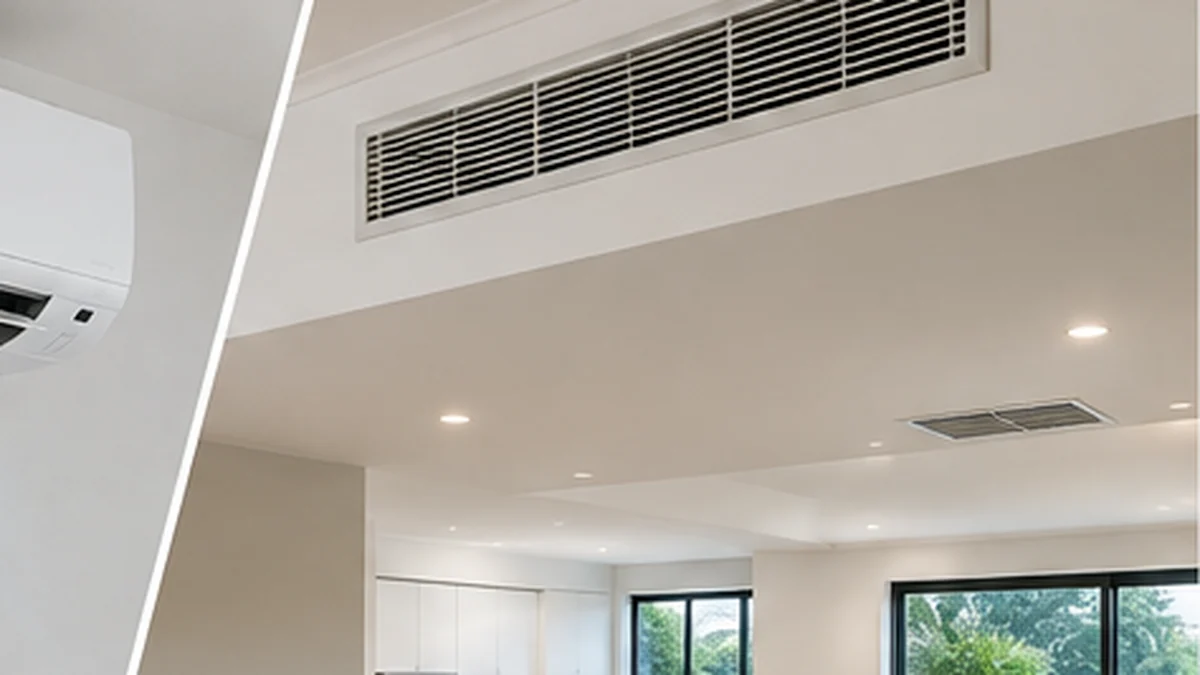
A ducted system has to move conditioned air from a central indoor unit through a network of ducts. The Australian Government notes two direct penalties: the larger fan needed to move air and energy lost through the ductwork. YourHome’s heating and cooling guidance adds that poorly insulated or poorly sealed ducts can suffer heat gain, heat loss, leakage and condensation, especially where ducts run through an unconditioned roof space.
The size of the area being conditioned is just as important. If a household runs one wall split in the living room, it is not fair to compare that with a ducted system cooling five bedrooms, hallways and the living area. The ducted system is doing more work. The cost question should therefore be framed as: what does it cost to condition the rooms we actually need?
Duct quality matters too. YourHome recommends well-insulated, sealed ductwork, short and straight runs where possible, correctly sized ducts and a proper return-air path. Those details are not minor installation choices: they influence how much useful heating or cooling reaches the rooms for each kilowatt-hour purchased.
Zoning can change the ducted running-cost picture
Zoning allows a ducted system to reduce or stop airflow to parts of the home that are not being used. YourHome specifically recommends designing ducted systems so the conditioned area can be controlled and unoccupied areas can be shut off. This can narrow the running-cost gap compared with conditioning the whole house continuously.
But a zone button does not automatically make a ducted system behave like a small wall split. The central unit still has minimum airflow and operating limits, and the electrical input does not necessarily fall in direct proportion to the number of closed zones. The result depends on the equipment, control strategy, duct design and minimum zone requirements. For a household with a ducted system, the practical approach is to compare measured or realistic average input with all zones open against the combinations you actually use.
For a household deciding before purchase, ask the designer to explain the minimum active zone, airflow requirements and how the proposed system modulates at part load. A design that is comfortable and efficient for your actual occupancy pattern is more useful than a headline capacity number.
A fair worked example: compare the same household schedule
Consider an illustrative household that wants six hours of evening cooling. These numbers are deliberately hypothetical so the arithmetic is transparent:
| Scenario | Average electrical input | 6-hour energy | Cost at $0.35/kWh |
|---|---|---|---|
| One occupied-zone split | 1.0kW | 6.0kWh | $2.10 |
| Ducted, two active zones | 1.9kW | 11.4kWh | $3.99 |
| Ducted, larger active area | 2.8kW | 16.8kWh | $5.88 |
Nothing in this table says that 1.0kW, 1.9kW or 2.8kW is “typical” for a system category. It simply shows how to turn a measured or assumed average input into a comparable cost. Replace the input values with manufacturer data, energy-monitoring data or a carefully chosen scenario for the systems you are assessing, and replace $0.35/kWh with the tariff on your bill.
If you only want the cost of your existing wall unit, the separate split system running cost guide focuses on input power, inverter operation and per-hour calculations. For the broader method across air-conditioner types, see how much an air conditioner costs to run in Australia.
Energy labels are useful, but ducted comparisons need care
For non-ducted household air conditioners, the Australian Zoned Energy Rating Label is a useful standardised comparison tool. The Zoned Energy Rating Label guide shows separate seasonal performance for hot, average and cold climate zones, plus annual energy-use estimates, capacity and noise information. Compare models of a similar size and suitable capacity; star ratings across very different capacities are not a like-for-like comparison.
Ducted systems are different. The Australian Government’s regulatory information for air conditioners up to 65kW explains that mandatory display of the Zoned Energy Rating Label is focused on specified non-ducted and single-split products, while other system types can have different label requirements. The official Energy Rating Calculator for air conditioners also notes that ducted units may show “N/A” for the star rating.
That means you should not reject a ducted quote simply because it lacks the same retail star label as a wall split. Ask for the system’s technical efficiency data, expected electrical input, zoning design and a load calculation. Then compare the service each option is expected to deliver in your home.
Correct sizing matters more than buying the biggest unit
Oversizing is not a shortcut to efficiency. YourHome warns that a system that is too large costs more to buy and can waste energy, while an undersized system has to work harder to meet the load. Climate, floor area, ceiling height, windows, orientation, shading, insulation, air leakage and occupancy all influence the required capacity.
The Energy Rating Calculator also treats correct sizing as the first step before model comparison. For major investments such as ducted heating and cooling, energy.gov.au recommends expert advice. A proper room-by-room or whole-home load assessment is more defensible than selecting equipment from floor area alone.
Climate changes the comparison as well. The Australian Government’s northern Australia cooling guidance specifically recommends cooling the room rather than the whole home where that meets the need, because non-ducted splits avoid duct-distribution losses. In other climates and households, heating demand, overnight use and simultaneous room occupancy may lead to a different practical design.
The house can matter as much as the air conditioner
Running cost is not only an appliance issue. Insulation, draught sealing, window shading and internal heat gains determine how quickly the home gains or loses heat. A poorly sealed room can keep a high-efficiency split working hard. A poorly insulated roof space can also increase load on a ducted system while exposing ducts to extreme temperatures.
Before paying for a larger system, reduce avoidable heating and cooling loads where practical. Energy.gov.au recommends measures such as gap sealing, curtains, exterior shading and roof, wall and floor insulation. If you can reduce the load, you may be able to operate either system for fewer hours or at lower average input.
Thermostat settings and maintenance affect both options
Both split and ducted systems use more energy when asked to maintain a bigger temperature difference from outdoors. Energy.gov.au says each extra degree of heating in winter or cooling in summer can increase energy use, so moderate settings are an important part of any cost comparison. Use the same comfort target when comparing systems; otherwise the result is not like for like.
Filters, coils, outdoor airflow and duct condition also matter. Government bench testing has found that common faults can raise energy use, and regular maintenance helps reduce avoidable losses. Follow the manufacturer instructions and use appropriately licensed technicians for work involving the refrigeration system.
What about several split systems instead of one ducted system?
This is often the real purchase decision. Two or three independent splits can let each room operate only when occupied, while a ducted system can provide a cleaner central layout and coordinated whole-home control. A multi-split connects several indoor heads to one outdoor unit and sits between those approaches.
Do not assume that three splits automatically use three times the electricity of one split, or that one large ducted compressor automatically uses less because there is only one outdoor unit. What matters is how many indoor zones are running, their loads, equipment efficiency and total electrical input over time.
For homes that rarely condition every room at once, independent room systems can avoid conditioning empty areas. For homes where many rooms genuinely need heating or cooling at the same time, a properly designed ducted system may offer practical comfort and control benefits. Running cost should be one input in the decision, not the only one.
How to compare quotes and running-cost claims
- Confirm the heating and cooling load or capacity required for the actual rooms.
- Separate output capacity from electrical input.
- Ask what zones can operate independently and what minimum active zone is required.
- Ask how the ducts will be insulated, sealed and routed.
- Compare efficiency data for your climate and a similar output capacity.
- Use the same thermostat target, hours and electricity tariff in every running-cost scenario.
- Keep installation cost separate from electricity running cost, then compare total ownership only after both are visible.
HomeBillLab’s calculation methodology keeps the energy input, runtime, tariff and assumptions visible so a result can be checked rather than accepted as a black-box “average”. You can browse the full Air Conditioning Energy Guide Australia for related calculations and operating guidance.
Frequently asked questions
Is a split system cheaper to run than ducted air conditioning?
Often, if the split system conditions only one occupied room while the ducted system conditions a much larger area. Ducted systems also have fan and duct-distribution losses. A well-zoned ducted system can reduce unnecessary conditioning, so compare actual electrical input and active area rather than relying on system type alone.
How do I calculate ducted air conditioning cost per hour?
Multiply the system’s realistic average electrical input in kilowatts by your electricity tariff in dollars per kilowatt-hour. For example, 2.5kW average input at $0.35/kWh is $0.875, or about $0.88 per hour. Do not use cooling capacity as if it were electrical input.
Does zoning make ducted air conditioning as cheap as a split system?
Not automatically. Zoning can reduce the conditioned area, but the central system still has fan, airflow and minimum-zone requirements. Measure or model the actual input for the zone combinations you expect to use.
Why does my ducted unit not have the same star label as a split?
Mandatory Zoned Energy Rating Label display requirements focus on specified non-ducted and single-split products. Ducted systems may not show a retail star rating, so compare technical efficiency data, capacity, design and expected input instead of assuming “no stars” means poor efficiency.
Should I install multiple splits instead of ducted air conditioning?
It depends on layout and occupancy. Multiple splits can suit homes where different rooms are used at different times. Ducted can suit households that frequently condition many rooms together. Compare load, equipment efficiency, control, installation constraints and running scenarios for your home.
Bottom line
For split system vs ducted air conditioning running costs, the biggest mistake is comparing names or advertised capacities instead of actual electricity use and conditioned area. A wall split has a strong running-cost advantage when it lets you condition only the room you are using. A ducted system can make sense for broader simultaneous comfort, especially when zoning, duct insulation, sealing and system sizing are done well.
Put both options through the Air Conditioner Running Cost Calculator using the same hours, tariff and comfort assumptions. Then compare the result with the service each system actually provides. That produces a more useful decision than any single “split versus ducted” national average.