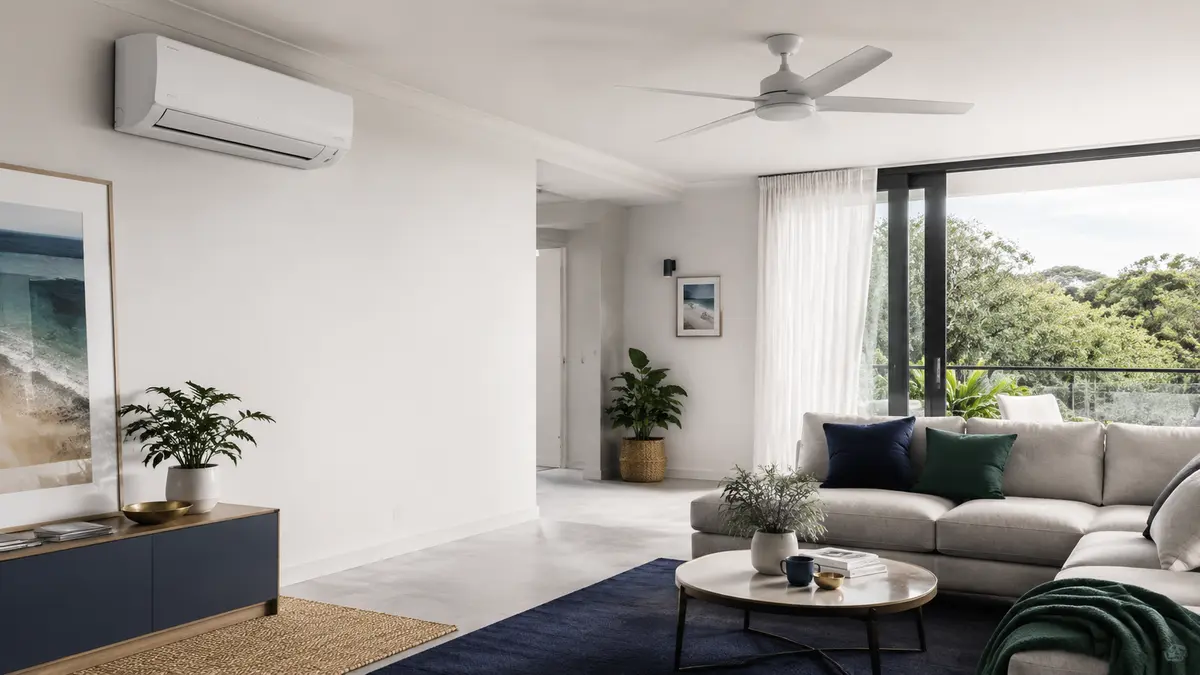
Air conditioner vs fan running cost is not a like-for-like comparison. A fan moves air across your skin and can make you feel cooler; an air conditioner removes heat from the room and may also reduce humidity. The fan will usually use far less electricity, but it cannot always provide the same result.
Quick answer: in an illustrative scenario at 32c/kWh, a 50W fan costs about 1.6 cents an hour, while an air conditioner averaging 1.2kW of electrical input costs about 38 cents an hour. Those figures are examples, not Australian averages. Your result depends on the equipment, weather, room, settings, runtime and tariff.
For a result based on your own numbers, enter the electrical input, operating time and tariff in the Air Conditioner Running Cost Calculator. This guide explains what the comparison means and how to make it fairly. You can also browse the complete air-conditioning guide hub.
Air conditioner vs fan running cost: example comparison
The table below uses a 32c/kWh electricity tariff and eight hours of operation per day. The two fan examples use their rated input power. The air-conditioner examples use average electrical input while operating, not cooling capacity.
| Cooling option | Example input | Cost per hour | Cost for 8 hours | Cost for 30 days |
|---|---|---|---|---|
| Fan | 50W | 1.6c | $0.13 | $3.84 |
| Fan | 75W | 2.4c | $0.19 | $5.76 |
| Air conditioner | 1.2kW average input | $0.38 | $3.07 | $92.16 |
| Air conditioner | 2.0kW average input | $0.64 | $5.12 | $153.60 |
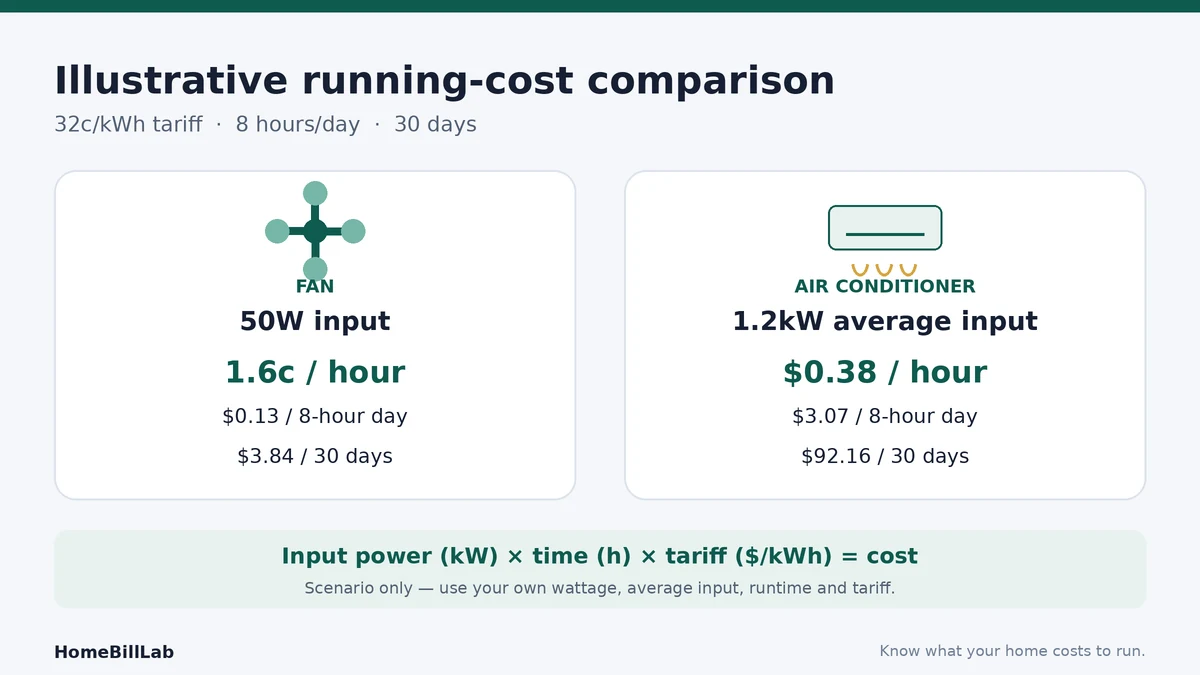
This example shows why a fan can be much cheaper to operate. It does not prove that either appliance will have that input in your home. Check the wattage on the fan label and the electrical input or energy label information for the air conditioner.
Why a fan costs less but does a different job
A fan drives a relatively small motor. It creates air movement but does not lower the room’s air temperature or remove humidity. The Australian Government’s YourHome heating and cooling guide explains that airflow can make people feel about 3°C cooler. It also gives examples ranging from a small 5W desktop fan to a 75W room fan, with efficient DC ceiling fans around 30W.
An air conditioner runs a compressor, fans and control electronics to transfer heat. Its electrical input can therefore be many times higher than a fan’s. Reverse-cycle systems can still be efficient at moving heat: the Australian Government’s heating and cooling guidance says they can deliver several units of heating or cooling for each unit of electricity used. That efficiency does not make their power draw equal to a fan; it explains why cooling capacity and electrical input are different numbers.
The practical choice depends on the task. A fan may be enough when the room is only moderately warm and moving air improves comfort. Air conditioning may be more appropriate when indoor heat or humidity remains high, when the building has absorbed heat, or when effective cooling is important for health.
How to calculate your own running cost
Use the same relationship for either appliance:
Running cost = input power (kW) × operating time (hours) × electricity tariff ($/kWh)
Convert watts to kilowatts by dividing by 1,000. A 50W fan is 0.05kW. At 32c/kWh, or $0.32/kWh:
- 0.05kW × 1 hour × $0.32/kWh = $0.016, or 1.6 cents.
- 0.05kW × 8 hours × $0.32/kWh = $0.128, or about 13 cents.
- $0.128 × 30 days = $3.84.
The Australian Government’s energy ratings guide recommends using the input power shown in watts or kilowatts and multiplying energy consumption by your electricity tariff. HomeBillLab uses the same transparent approach. See the HomeBillLab Methodology for formulas, rounding and limitations.
Finding the right power figure for a fan
Look for watts on the rating label, specification sheet or manufacturer’s product page. Use the power for the speed you normally select if the manufacturer provides separate values. Do not assume every ceiling, pedestal, tower or desk fan has the same wattage.
If the label shows only volts and amps, the simple multiplication of those figures may not equal the real power used by an AC motor. A plug-in energy meter can provide a more useful measured input for a portable fan. You can enter that measured wattage in the Appliance Running Cost Calculator.
Speed matters. A fan’s highest setting generally uses more electricity than its lower settings. Standby power may add a small amount for models with remote controls or smart features, but operating power and runtime will usually dominate the comparison.
Finding the right air-conditioner input
Do not use the large 2.5kW, 5kW or 7kW cooling-capacity number as though it were electricity use. That figure describes how much cooling the system can deliver. Electrical input is a separate, normally smaller figure measured in watts or kilowatts.
Inverter air conditioners complicate an hourly estimate because their input changes. They may work hard after startup, then slow down once the room approaches the set temperature. Outdoor temperature, humidity, insulation, room size, open doors, sun exposure, filters and thermostat setting can all affect the average input.
Use a measured or realistic average input where possible. For an annual comparison, the annual cooling and heating consumption on the Zoned Energy Rating Label can be more useful than multiplying a maximum input by every hour. Our guide to how much electricity an air conditioner uses explains the difference between input, capacity and kWh in more detail.
Should you use a fan, air conditioner, or both?
Use a fan first when it provides enough comfort
The Australian Government’s summer energy-saving guidance recommends trying fans first and notes that they need to blow on a person to create the cooling effect. This can be a low-cost option during milder conditions, particularly when a breeze and shading keep indoor temperatures manageable.
Use air conditioning when the room needs active cooling
An air conditioner changes the indoor conditions rather than only changing how moving air feels. Close doors and windows in the cooled zone, limit direct sun with blinds or curtains, and cool only occupied areas where practical. These steps reduce the heat the system must remove.
Combine a fan with air conditioning carefully
A fan can help distribute cooled air and may let occupants remain comfortable at a higher thermostat setting. Government guidance commonly suggests a cooling setting around 25°C to 27°C, subject to comfort and health needs. The extra fan power may be small compared with the air-conditioning energy avoided, but the outcome depends on whether the thermostat is actually adjusted and whether the air conditioner reduces its input or runtime.
Ways to reduce cooling cost without hiding assumptions
- Use your actual tariff. Copy the usage rate in cents per kWh from your electricity bill or plan. A national example cannot represent every household.
- Model realistic hours. Separate occasional hot days from daily summer use instead of multiplying a worst-case day across the whole year.
- Cool occupied spaces. Shut off unused zones where the system and home layout allow it.
- Block heat before it enters. Use external shading where available and close curtains or blinds during the hottest part of the day.
- Use cooler outdoor air at the right time. Cross-ventilation can help when outdoor conditions are cooler than indoors.
- Maintain airflow. Follow the manufacturer’s instructions for cleaning filters and keeping outdoor units unobstructed.
- Compare scenarios. Test the fan alone, air conditioner alone, and combined use in separate calculations.
These actions affect running cost differently in each home. The important point is to change one assumption at a time and keep the inputs visible. That makes the air conditioner vs fan running cost comparison useful rather than falsely precise.
Do not let cost override heat safety
Cost matters, but it is not the only consideration during hot weather. Healthdirect Australia recommends staying hydrated and keeping your environment cool, including with fans or air conditioning where appropriate. Follow current health and emergency advice during severe heat, and give extra care to people who may be more affected by hot conditions.
Frequently asked questions
Is a fan cheaper to run than an air conditioner?
Usually, yes. A fan commonly has much lower electrical input than an air conditioner. However, it moves air rather than removing heat from the room, so the two appliances do not provide identical cooling.
How much does a fan cost to run for eight hours?
Multiply its power in kilowatts by eight hours and your tariff. A 50W fan at 32c/kWh costs 0.05 × 8 × $0.32 = $0.128, or about 13 cents. Replace both example inputs with your own.
Is it cheaper to run a fan and air conditioner together?
It can be cheaper than running the air conditioner at a colder setting if the fan lets you raise the thermostat and the system then uses less electricity. Simply adding a fan without changing air-conditioner operation adds the fan’s cost.
Does a fan cool an empty room?
No. A normal fan does not lower room air temperature; its airflow helps people feel cooler. Turn it off when nobody benefits from the airflow, unless it has another deliberate ventilation purpose.
Does supply charge belong in this comparison?
No. The daily supply charge is generally paid regardless of whether the fan or air conditioner operates. An appliance running-cost comparison normally uses the variable electricity usage rate only. Time-of-use households can calculate separate scenarios using the rate that applies during cooling hours.
Bottom line
A fan is generally the lower-cost option when air movement provides enough comfort. Air conditioning uses more electricity but actively cools the space and may be necessary in hotter or more humid conditions. For a fair air conditioner vs fan running cost comparison, use each appliance’s electrical input, the same operating period and your own electricity tariff—and remember that they do different jobs.
Reviewed: 22 August 2026. This guide provides calculation guidance, not a quote for a particular appliance, electricity plan or home.