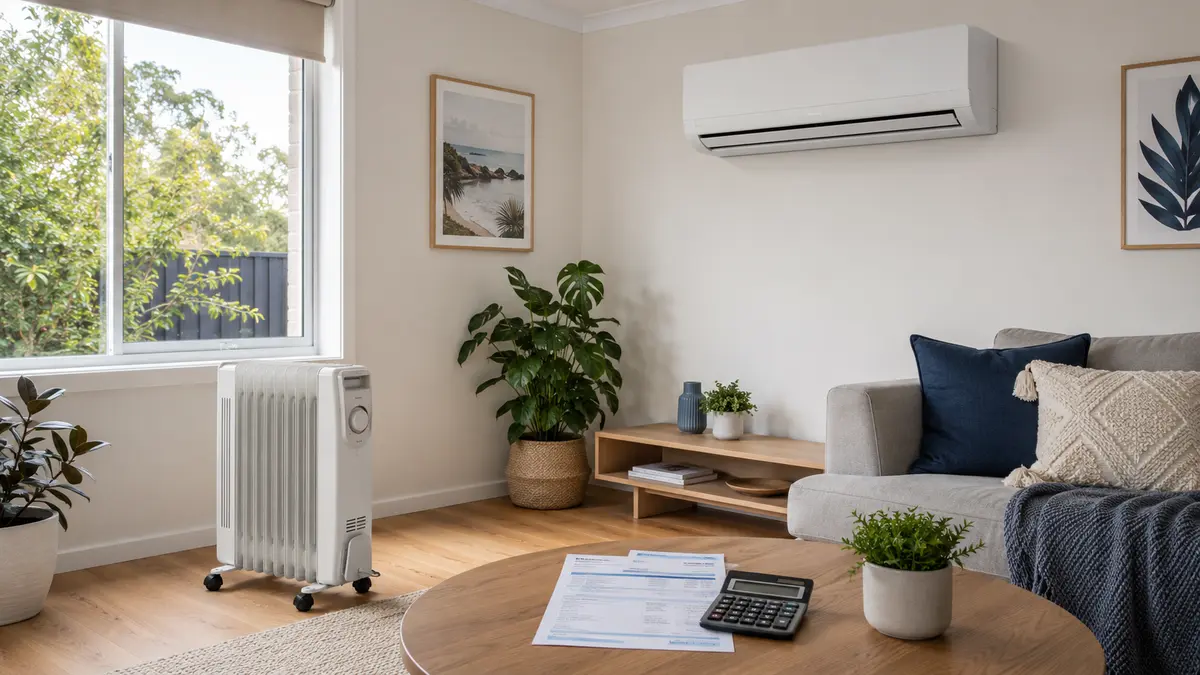
Electric heater vs reverse cycle air conditioner running cost is mainly a comparison between direct resistance heating and a heat pump. A plug-in electric heater turns electricity directly into heat, while a reverse-cycle system uses electricity to move heat from outdoors into the room.
Quick answer: at 32c/kWh, a 2kW direct electric heater costs 64c per hour while drawing full power. A reverse-cycle air conditioner averaging 0.8kW of electrical input costs about 26c per hour. That does not prove the two devices delivered identical heat or comfort; capacity, COP, room conditions and thermostat cycling must also be considered.
Use the Heating Running Cost Calculator Australia to test electric heater vs reverse cycle air conditioner scenarios with your own input power, runtime, efficiency assumption and electricity tariff.
Electric heater vs reverse cycle air conditioner cost examples
The first table compares electrical input over the same five-hour period. It does not claim equal heat output.
| Illustrative input | Electricity for 5 hours | Cost at 32c/kWh | 30-day equivalent |
|---|---|---|---|
| 1.5kW direct heater | 7.5kWh | $2.40 | $72.00 |
| 2.0kW direct heater | 10.0kWh | $3.20 | $96.00 |
| 0.8kW average reverse-cycle input | 4.0kWh | $1.28 | $38.40 |
| 1.2kW average reverse-cycle input | 6.0kWh | $1.92 | $57.60 |
The hourly formula is the same for both appliances:
Cost per hour = average electrical input (kW) × electricity tariff ($/kWh)
A tariff of 32c/kWh is used only to make the arithmetic visible. It is not a national average. Replace it with the rate that applies when heating runs.
For a useful electric heater vs reverse cycle air conditioner comparison, keep the tariff, room and comfort target consistent while changing only the appliance inputs you are testing.
Why the two heaters use electricity differently
A resistance heater passes electricity through an element. At the appliance, almost all electrical input becomes room heat. Different resistance designs—fan heaters, panel heaters, oil-filled columns and radiant heaters—can feel different, but one does not create several units of heat from one unit of electricity.
A reverse-cycle air conditioner is an air-source heat pump. It transfers heat rather than generating all heat directly. The Australian Government’s heating and cooling guide states that reverse-cycle models on the Australian market can operate at roughly 300% to 600% efficiency. In heat-pump terms, that is broadly comparable to a COP range of 3 to 6 under stated conditions.
This does not break the laws of energy. The extra delivered heat is collected from outdoor air. Actual seasonal performance varies with model, climate, temperature set point, installation, defrost cycles and part-load operation.
Compare the same delivered heat
A fair efficiency comparison holds useful heat constant. Suppose a room needs 2kWh of delivered heat during a simplified period:
- Direct resistance: at an assumed COP of 1.0, electrical input is 2.00kWh and costs $0.64 at 32c/kWh.
- Reverse cycle: at an assumed COP of 3.5, electrical input is about 0.57kWh and costs about $0.18 at 32c/kWh.
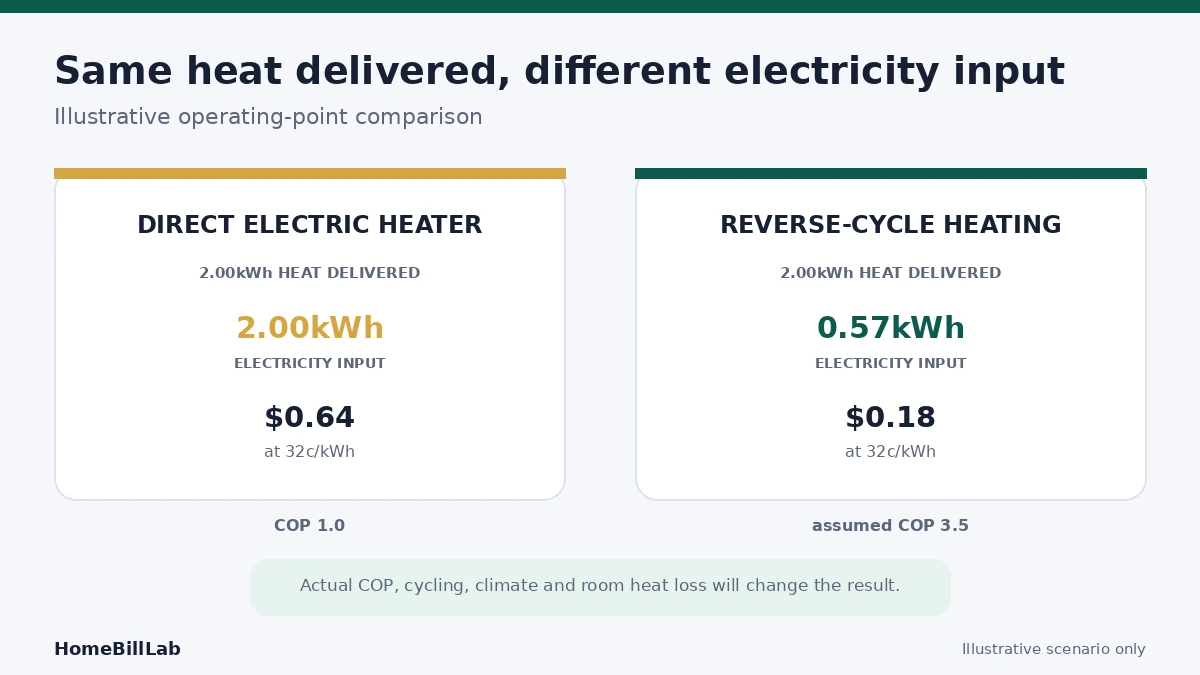
The COP of 3.5 is an illustrative operating assumption, not a guaranteed annual rating. The example excludes standby energy and does not model heat distribution, cycling or defrost. Its purpose is to show why reverse-cycle heating can deliver the same heat with less electricity.
Do not confuse heating capacity with electrical input
A split system may list 5kW of heating capacity. That is heat delivered, not necessarily electricity drawn. Multiplying 5kW by the tariff as though it were input power can substantially overstate running cost.
Look for input power, annual or seasonal electricity, or defensible monitored consumption. If only heating capacity and COP are available, estimate:
Electrical input (kW) = heating output (kW) ÷ COP
For 3.5kW of delivered heat at COP 3.5, estimated input is 1.0kW at that operating point. The compressor may later slow down, cycle or increase input as conditions change. The guide on how much electricity an air conditioner uses explains the power-versus-energy distinction in more detail.
How to use the Zoned Energy Rating Label
The Zoned Energy Rating Label provides heating and cooling information for hot, average and cold climate zones. Use the heating side of the label and compare models with similar heating capacity that are correctly sized for the space.
The official Energy Rating heating and cooling guide explains the three climate-zone ratings. Its guide to understanding the Zoned Energy Rating Label warns that star ratings for models of different capacity should not be compared in isolation. A larger system can use more electricity even when it has the same star rating.
Label figures are standardised comparison tools, not a prediction of one household’s exact bill. Climate, room size, insulation, doors, windows and user settings still matter.
Inverter operation changes average input
An inverter compressor can vary its speed. It may draw more power while warming a cold room, then reduce input as the room approaches the thermostat setting. Quoting only maximum input can overstate typical operation, while quoting only a low steady-state draw can understate warm-up and cold-weather use.
For an existing system, a suitable plug-in meter can measure some single-phase appliances, but fixed-wired air conditioners require an appropriate monitoring method and qualified assistance. Use manufacturer documentation or circuit monitoring rather than opening electrical equipment.
Climate and defrost affect reverse-cycle heating
As outdoor temperature falls, a system may have less heat available from the air and its efficiency can change. Frost on the outdoor coil can trigger defrost operation, temporarily changing electricity use and heat delivery. Models differ, so a single COP should not be applied to all Australian climates.
YourHome heating and cooling guidance identifies heat pumps as highly efficient but stresses climate-appropriate design and correct sizing. Use the climate-zone label, manufacturer operating range and installer calculations when choosing a system.
Room size and insulation can dominate the bill
A draughty or poorly insulated room loses heat faster, so either appliance must run longer or work harder. Ceiling height, glazing, floor, wall area, air leakage, sun, outdoor temperature and the number of open rooms all change the heating load.
Close unused areas when appropriate, seal avoidable draughts and improve insulation before treating appliance efficiency as the only variable. A correctly sized reverse-cycle unit serving the intended zone is a different comparison from a small portable heater warming one person briefly.
This is why an electric heater vs reverse cycle air conditioner result should describe the heated area and operating schedule, not just quote two hourly prices without context.
Thermostat setting and runtime
Higher indoor temperatures increase the heat that must be supplied and can lengthen runtime. The Australian Government’s winter energy guide recommends a heating set point between 18°C and 20°C and says every additional degree can add around 5% to 10% to heating energy costs.
Use that as general guidance rather than adding a fixed percentage to every estimate. Weather, building performance and control strategy determine the actual change. Compare scenarios with the same comfort target and schedule.
Tariff and bill treatment
Use the tariff that applies during heating hours. A time-of-use customer may pay different rates in morning, daytime and evening periods. Run separate scenarios when usage crosses several tariff windows.
The Australian Energy Regulator’s bill guide distinguishes variable usage charges from the daily supply charge. The fixed household supply charge normally does not belong in an appliance-only comparison because it remains even when the heater is off.
Use How to Read an Electricity Bill in Australia and Supply Charge vs Usage Charge to identify the correct input.
When can a portable electric heater make sense?
Lower running cost per unit of delivered heat does not settle every purchase decision. A portable resistance heater may have a low purchase price and can be practical for short, occasional heating of a small occupied zone. If it runs briefly while a larger system would heat several unused rooms, total electricity may be modest.
The electric heater vs reverse cycle air conditioner decision should therefore separate hourly energy cost from purchase price, installation and the number of rooms that will actually be heated.
For regular heating over longer periods, reverse-cycle efficiency often gives it a running-cost advantage. The Australian Government’s electrification guide identifies reverse-cycle split systems as efficient electric heating and cooling technology. Compare installed cost, ownership period, maintenance, space served and annual use separately from hourly running cost.
A fair electric heater vs reverse cycle air conditioner test
- Define the same room or occupied zone and the same comfort target.
- Use actual electrical input, not heat-output capacity.
- Record comparable warm-up and steady-state periods.
- Apply the tariff that operated during each period.
- Note outdoor temperature, doors, windows and thermostat settings.
- Repeat across more than one day instead of relying on a single short reading.
- Separate running cost from purchase and installation cost.
For a calculator-only comparison, keep runtime and tariff constant, then test a defensible average input for each appliance. If comparing equal heat, state the COP assumption explicitly.
Use electric heating safely
Keep portable heaters stable and clear of curtains, bedding, clothing and other combustible materials. Follow the product’s clearance instructions, do not cover it and switch it off when leaving or sleeping. Do not use a portable heater in a wet area.
Energy Safe Victoria’s electrical safety guidance warns against portable heaters in bathroom areas and stresses extra care around water. Fixed air-conditioning work, new circuits and electrical repairs require appropriately qualified tradespeople. Do not open, rewire or modify either appliance to reduce running cost.
Frequently asked questions
Which is cheaper: electric heater vs reverse cycle air conditioner?
For the same delivered heat, an efficient reverse-cycle system normally uses less electricity because it moves heat. Actual cost still depends on COP, room load, runtime and tariff. A portable heater may cost less in total for very short, targeted use because there is no installation cost.
Does a 5kW reverse-cycle unit use 5kW of electricity?
Not necessarily. The 5kW figure may be heating capacity. Find electrical input or estimate input by dividing delivered heating capacity by COP at stated conditions.
Are all plug-in electric heaters equally expensive to run?
Two resistance heaters drawing the same average electrical power for the same time use similar kWh. Their controls, heat distribution and how people use them can still change runtime and comfort.
Can the reverse-cycle label predict my exact bill?
No. It supports standardised product comparison. Your climate, building, set point, operating hours and tariff determine the household result.
Should supply charges be included?
Normally not in an appliance-level comparison because the household pays the fixed connection charge regardless. Include only a fixed cost that exists specifically because of the heating option.
Bottom line
A defensible electric heater vs reverse cycle air conditioner comparison uses average electrical input, consistent runtime and the tariff on your bill. For equal heat, state the reverse-cycle COP and operating conditions. Do not use heating capacity as electricity consumption, and do not present one illustrative cost as an Australian household average.
See the HomeBillLab methodology, browse the Australian heating guide hub, or compare related cooling demand in Air Conditioner vs Fan Running Cost.
Reviewed: 22 August 2026. This guide provides transparent calculations and illustrative scenarios, not a quote, national average or product recommendation. Electrical installation and repair work must be performed by an appropriately qualified and licensed professional.